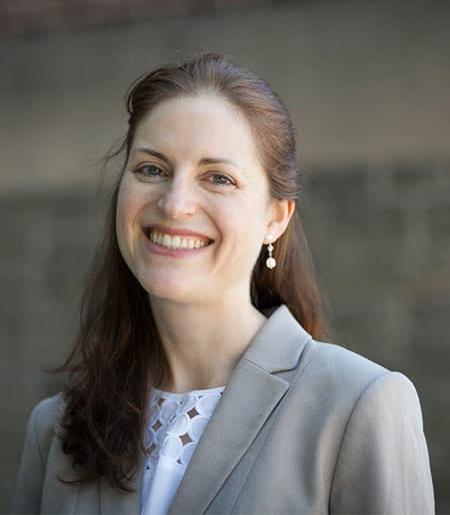
Overview
Slayton’s research and teaching examine the relationships between and among risk, governance, and expertise, with a focus on international security and cooperation since World War II. Her first book, Arguments that Count: Physics, Computing, and Missile Defense, 1949-2012 (MIT Press, 2013), shows how the rise of a new field of expertise in computing reshaped public policies and perceptions about the risks of missile defense in the United States. In 2015, Arguments that Count won the Computer History Museum Prize.
Slayton’s second book project, Shadowing Cybersecurity, examines the emergence of cybersecurity expertise through the interplay of innovation and repair. This project was supported by a five-year National Science Foundation CAREER award, “Enacting Cybersecurity Expertise.� In 2019, Slayton was a recipient of the United States Presidential Early Career Award for Scientists and Engineers, for her NSF CAREER project.
Research Focus
History of computing; peace and conflict studies; history of science and technology; risk; expertise
Affiliations
Publications
Academic Articles and Chapters
- Rebecca Slayton and Lilly Muller, “,� Social Studies of Science 55 no. 4 (2025): 481-511.
- Rebecca Slayton and Claire Stevens, “,� Robert Jervis International Security Studies Policy Roundtable on the Practices and Politics of Cybersecurity Expertise, March 29, 2024.
- Yue Zhao and Rebecca Slayton, ", 1989-2010," IEEE Annals of the History of Computing 45 no. 1 (2023): 43-54.
- Rebecca Slayton, "(De)stabilizing Cyber Warriors: The Emergence of U.S. Military Cyber Expertise, 1967-2018," 117-213 in , eds. Robert Chesney, James Chires, Max Smeets (Edinburgh: Edinburgh University Press, 2023)
- Rebecca Slayton, "Introduction: The Early Lives and Lasting Legacies of Whitfield Diffie and Martin Hellman, 1-16 in Rebecca Slayton (ed) (New York, NY: ACM Books, 2022).
- Slayton, Rebecca (2021) "." Texas National Security Review 4(1).
- Slayton, Rebecca and Brian Clarke (2020) "." Technology & Culture 61(1): 173-206.
- Aaron Clark-Ginsberg and Rebecca Slayton (2019) "" Science and Public Policy 46(3): 339-346.
- Slayton, Rebecca, and Aaron Clark-Ginsberg (2018) . Regulation & Governance 12(1), 115-130.
- Slayton, Rebecca (2017) “.� International Security 41(3): 72-109.
- Slayton, Rebecca (2016) “.� in Communities of Computing: Computer Science and Society in the ACM, edited by Thomas Misa, 282-323. New York: ACM Press.
- Slayton, Rebecca, and Graham Spinardi (2016) “,� Technovation 47: 47-58.
- Slayton, Rebecca (2015) “,� IEEE Annals in the History of Computing 37(2): 32-45.
- Spinardi, Graham, and Rebecca Slayton (2015) “.� Science & Technology Studies 28(1): 28-51.
- Slayton, Rebecca (2013) “.� Information and Culture 48(4): 448-478.
- Slayton, Rebecca (2012) Historical Studies in the Natural Â鶹ÊÓƵ 42(4): 255-282.
Public Outreach Articles and Briefs
- “,� U.S. Congressional Briefing, American Historical Association, October 29, 2025.
- "," International Security Studies Forum, January 21, 2021. With Jason Ludwig.
- “� Texas National Security Review Policy Roundtable on Artificial Intelligence and International Security, June 2, 2020.
- "." Washington Post Monkey Cage, April 18, 2019.
- “.� International Security Studies Forum, April 2018.
- “.� Policy brief at the Belfer Center for Science and International Affairs, Harvard Kennedy School, 2017.
- “,� Limn 8, 2017.
- “.� White paper for Columbia University’s School of International and Public Affairs, 2016
- “.� Federation of American Scientists Public Interest Report 67(3), 2014.
In the news
- Balancing various uncertainties in cyber threat intelligence
- Roundtable to consider ‘Science Under Siege’
- Ban on Chinese tech in connected vehicles ‘extremely difficult’ to enforce
- Grants advance social sciences research, collaboration
- Lund Critical Debate to examine global policing, social justice
- American history scholar Richard Polenberg dies at 83
- The Dilemma of Cybersecurity
- China’s global data security initiative is “wholly aspirational�
- Cybersecurity requires international cooperation, trust
- Migrations initiative announces cross-campus awards
- Three A&S faculty win White House early career awards
- Einaudi Center welcomes new program directors
- NYC health commissioner addresses health inequality in lecture
- Artist visits campus in conjunction with Urban Representations Lab course
- Working group: Give citizens say in nuclear accident plans