Overview
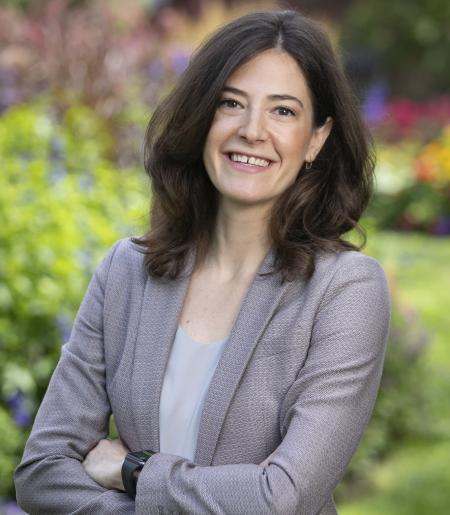
Bryn Rosenfeld is an Associate Professor of Government at Cornell University and a co-Principal Investigator of the , supported by the National Science Foundation and the National Council for Eurasian and East European Research. Her research interests include comparative political behavior, with a focus on regime preferences and voter behavior in nondemocratic systems, development and democratization, protest, post-communist politics, and survey methodology.
Her first book, (Princeton University Press, 2021), explains how middle-class economic dependence on the state impedes democratization and contributes to authoritarian resilience. It won the 2022 Best Book award from the APSA's Democracy & Autocracy section, the Ed A. Hewett Book Prize for outstanding publication on the political economy of Russia, Eurasia and/or Eastern Europe by the Association for Slavic, East European, and Eurasian Studies (ASEEES), and an Honorable Mention for the APSA's William H. Riker award for best book in political economy. She is also the recipient of a Frances Rosenbluth best paper prize, as well as a Best Article Award honorable mention and Juan Linz Prize for Best Dissertation, both by the APSA's Democracy & Autocracy section.
Her articles appear in the American Political Science Review, the American Journal of Political Science, the Journal of Politics, the Annual Review of Political Science, Comparative Political Studies, and Sociological Methods & Research, among other outlets.
Prior to joining the faculty at Cornell, she was an Assistant Professor of Political Science at the University of Southern California and a Postdoctoral Prize Research Fellow at Nuffield College, University of Oxford. She is also a former editor of The Washington Post’s Monkey Cage blog and has worked for the U.S. State Department’s Office of Global Opinion Research, where she designed and analyzed studies of public opinion in the former Soviet Union. She holds a Ph.D. from Princeton University.
Media
Newsweek -- 04/30/2025
Center for Strategic & International Studies podcast --
Trump Posture on Ukraine Peace Based on Flawed Assumptions
A&S Communications --
Bloomberg -- 02/18/2025
and 15 other media outlets
Stanford -- 12/03/2024
The New Statesman -- 04/05/2024
and 2 other media outlets
Foreign Affairs -- 03/25/2024
AP -- 03/14/2024
and 431 other media outlets
Russia’s presidential election is ‘not so important’ as what will come after
A&S Communications -- 03/11/2024
Law and Justice party seeing ‘double rebuke’ from voters
A&S Communications -- 10/18/2023
ETH Zurich -- 02/01/2023
Washington Post -- 12/29/2022
Professor wins award for book about middle class and democracy
A&S Communications -- 11/18/2022
Vox -- 09/25/2022
and 8 other media outlets
Biden admin rhetoric strengthens Russian propaganda about U.S.
A&S Communications -- 04/25/2022
Euronews -- 04/15/2022
and 1 other media outlet
Washington Post -- 02/11/2022
The Washington Post -- 06/29/2021
Democracy Paradox Podcast -- 01/26/2021
Middle class actually enables autocrats in post-Soviet countries
Cornell Chronicle -- 12/07/2020
Washington Post -- 09/10/2020
Research Focus
Comparative Politics, Political Behavior, Development and Democratization, Authoritarian Regimes, Protest, Post-communism, Survey Methods
In the news
- Cornell scholars address global democratic erosion in book
- Even if a ‘peace’ deal is reached, Russia won’t give up on Ukraine
- Trump posture on Ukraine peace based on flawed assumptions
- Russia’s presidential election is ‘not so important’ as what will come after
- Law and Justice party seeing ‘double rebuke’ from voters
- Cornell Center for Social Â鶹ÊÓƵ names 14 faculty fellows
- Professor wins award for book about middle class and democracy
- Biden admin rhetoric strengthens Russian propaganda about U.S.
- Experts: Ukraine war puts world in ‘uncharted territory’
- Russia may be about to invade Ukraine. Russians don’t want it to.
- The Kremlin has a new toolkit for shutting down independent news media
- Middle class actually enables autocrats in post-Soviet countries
- Putin’s support is weakening. Will that show up in Russia’s regional elections this weekend?
- Social sciences center awards COVID-19 grants
- First visiting journalist shares world of the NYT with students, faculty