Overview
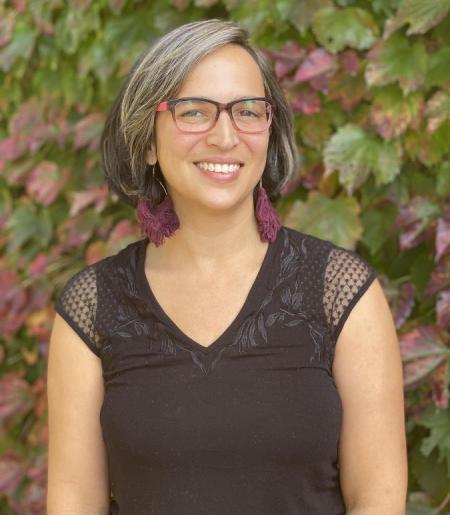
Ananda Cohen-Aponte is Associate Professor of History of Art who specializes in the visual culture of pre-Hispanic and colonial Latin America. Her research centers on issues of racial formation, cross-cultural exchange, historicity, and coloniality in the visual and material culture of the Andes. Her research also attends to legacies of colonialism in contemporary Latinx art. She is author of (University of Texas Press, 2016), which examines the intersections between art, politics, religion, and society in mural paintings located in colonial churches across the southern Andes. Cohen-Aponte served as editor and primary author of the book , published as separate Spanish and English-language editions by Haynanka Ediciones in 2015.
Cohen-Aponte is an award-winning scholar whose essays appear in a range of journals and edited volumes, including Colonial Latin American Review, The Americas, Allpanchis, RES: Anthropology and Aesthetics, and Latin American and Latinx Visual Culture, among others. Her article "Forging a Popular Art History: Indigenismo and the Art of Colonial Peru" (2017) is the fourth most read article in the history of RES: Anthropology and Aesthetics. She won the Association for Latin American Art (ALAA) Article Prize for her essay "Decolonizing the Global Renaissance: A View from the Andes" (2017). She received Honorable Mention for the Franklin Pease G.Y. Memorial Prize for the best article to appear in Colonial Latin American Review in the past two years (2013–2014) for "Painting Andean Liminalities at the Church of Andahuaylillas, Cuzco, Peru."
Her new book project, Insurgent Imaginaries: The Art of Rebellion in the Colonial Andes, considers the role of visual culture in both quotidian and spectacular acts of resistance within the context of anti-colonial uprisings of the late eighteenth century. She introduces new methodological frameworks to investigate occluded art histories of Indigenous and Afrodescendant resistance marked by state-sanctioned erasure. Cohen-Aponte has published several articles and essays based on this new research, including (2021) in the journal Selva and (2021) in the edited volume Visual Culture and Indigenous Agency in the Early Americas.
Cross-disciplinary, intergenerational collaboration forms an essential part of her research praxis. Her ongoing partnership with Dr. Elena FitzPatrick Sifford has resulted in widely shared and cited articles that call for a more inclusive future for the discipline of art history. Their co-authored article "A Call to Action" (2019) is the second most read article of all time in Art Journal and has been incorporated in the issued by the College Art Association. Their co-edited dossier published in the journal Latin American and Latinx Visual Culture has been used as a resource for recruiting more BIPOC undergraduate and graduate students into the field.
Collaborations with Dr. Ella Maria Diaz, Dr. Jolene Rickard, and artist Sandy Rodriguez have brought greater visibility to hemispheric entanglements of art, ecology, and migration. Their ongoing project invites students, scholars, community partners, and invited artists into an immersive learning environment that addresses intersecting histories of Chicanx, Indigenous, and Latinx place-based knowledges and ontologies through the lens of the visual, textual, and performative arts. This project received generous support from Global Cornell and the Mellon Foundation's Just Futures Initiative.
Dr. Cohen-Aponte was awarded the for her commitment to undergraduate advising and has received recognition for continued efforts to create equity in the discipline of art history through a pilot project called "Pathways to Art History." She recently completed a nine-year term of service (as Secretary-Treasurer, Vice President, and President) for the , an affiliated society of the College Art Association dedicated to supporting and expanding scholarly knowledge on the arts of Latin America.
Publications
Selva: A Journal of the History of Art 3 (2021).
"� in Visual Culture and Indigenous Agency in the Early Americas, ed. Alessia Frassani (Leiden: Brill, 2021), 188-210.
"Forjando una historia del arte popular: Indigenismo y el arte colonial peruano," in Arte antes de la historia, ed. Marco Curatola Petrocchi, Joanne Pillsbury, and Lisa Trever (Lima: Pontificia Universidad Católica del Perú, 2020), 189-212. An edited and abbreviated Spanish translation of "Forging a Popular Art History: Indigenismo and the Art of Colonial Peru."
(co-authored with Elena FitzPatrick Sifford), a co-edited “Dialogues� (including essays by Beatriz Balanta, Kency Cornejo, Arlene Dávila, Emmanuel Ortega, Rose Salseda, and Lawrence Waldron), Latin American and Latinx Visual Culture 1, no. 3 (2019): 60-100.
(co-authored with Ella Maria Diaz), English Language Notes 57, no. 2 (2019): 22-42.
RES: Anthropology and Aesthetics 67-68 (2016-2017): 273-289.
in The Globalization of Renaissance Art: A Critical Review, ed. Daniel Savoy (Leiden: Brill, 2017), 67-94.
** Received Association for Latin American Art (ALAA) Award for Best Article or Essay Published in Latin American Art History in 2017-2018.
(University of Texas Press, 2016).
(digital supplement to Heaven, Hell, and Everything in Between published by MAVCOR: Center for the Study of Material and Visual Cultures of Religion, Yale University, 2016).
(served as editor and principal author) (Haynanka Ediciones, 2015).
," The Americas 72, no. 1 (2015): 103-140.
," in Envisioning Others: Race, Color, and the Visual in Iberia and Latin America, ed. Pamela Patton (Leiden: Brill, 2015), 187-212.
," Allpanchis XI.II, no. 77-78 (2014): 11-48.
," Colonial Latin American Review 22, no. 3 (2013): 369-399.
** Awarded Honorable Mention for the Franklin Pease G. Y. Memorial Prize for the best article to appear in Colonial Latin American Review in 2013-2014).