Overview
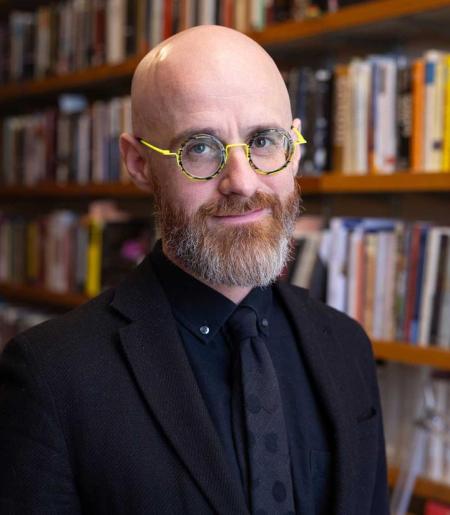
is Associate Professor in the Department of Government. His primary areas of research are democratic theory, social movements, religion and politics, and the history of twentieth-century political thought. His areas of specialization include American and African American political thought.
Livingston has published two books, most recently an edited volume on the dialogical approach to political theory developed by the Canadian political theorist James Tully and its contributions to the study of democracy, citizenship, and decolonization, (Routledge, 2022). His first book, (Oxford University Press, 2016), examines pragmatist philosopher William James鈥檚 critique of knowledge and authority in the context of struggles against American overseas imperialism at the turn of the twentieth century.
His current research program examines the history of nonviolence as strategy of contention, a practice of world-making, and a language of political thought. Projects in contribution to this larger program include a book manuscript on the sermons of Martin Luther King Jr. and his unexamined contributions as a theorist of power, as well as a new co-edited volume of the political writings of Mohandas K. Gandhi.
In addition to these monographs, Livingston's research has appeared in , , , , and , as well as numerous edited volumes including , , and . His public writing has appeared in and .
Before coming to Cornell, he was a Social Science and Humanities Research Council postdoctoral fellow in the Department of Political Science at Johns Hopkins University. He received his Ph.D. from the University of Toronto.
Research Focus
- American and African-American Political Thought
- Democratic Theory
- Civil Disobedience
- Social Movements
- Religion and Politics
Publications
Books:
- James Tully: To Think and Act Differently (London: Routledge, 2022)
- Damn Great Empires! William James and the Politics of Pragmatism (New York: Oxford University Press, 2016)
Selected Articles and Chapters:
- "Letter from a Birmingham Jail," in The Oxford Handbook of Political Obligation, ed. George Klosko (New York: Oxford University Press, forthcoming)
- "Decarcerating Civil Disobedience: Punishment, Policing, and the Problem of Innocence," in Research Handbook on Liberalism, ed. Duncan Ivison (Cheltenham: Edward Elgar Publishing, 2024), pp. 254-274
- "In Extremis: The Wildness of William James," Contemporary Pragmatism 19, no. 1 (2022): 23-34
- "Nonviolence and the Coercive Turn," in The Cambridge Companion to Civil Disobedience, ed. William E. Scheuerman (Cambridge: Cambridge University Press, 2021), 254-279
- "Thinking with the Streets: Civil Disobedience between Theory and Practice," Contemporary Political Theory 19, no. 3 (2020): 539-544
- "Tough Love: The Political Theology of Civil Disobedience," Perspectives on Politics 18, no. 3 (2020): 851-866
- "Power for the Powerless: Martin Luther King, Jr.'s Late Theory of Civil Disboedience," Journal of Politics 82, no. 2 (2020): 700-713
- "Fidelity to Truth: Gandhi and the Genealogy of Civil Disobedience," Political Theory 46, no. 4 (2018): 511-536
- 鈥淭he Cost of Liberty: Sacrifice and Survival in Du Bois鈥檚 John Brown,鈥� in A Political Companion to W.E.B. Du Bois, ed. Nick Bromell (Lexington: University Press of Kentucky, 2018), pp. 207-240
- 鈥淏etween Means and Ends: Reconstructing Coercion in Dewey鈥檚 Democratic Theory,鈥� American Political Science Review 111, no. 3 (2017): 522-534
In the news
- New summer course to spark civic engagement in high schoolers
- Booker鈥檚 speech: A retreat from the 鈥榓cquiescent liberal elite鈥� and an embrace of 鈥榞ood trouble鈥�
- Klarman Fellow headed to Yaddo residency
- Jane Bennett to deliver Culler Lecture in Critical Theory
- Humanities scholars research free speech, AI, sports culture and the Supreme Court
- Ghosh to lead Cornell鈥檚 Society for the Humanities
- Twelve new Klarman Fellows to pursue innovative, timely research in A&S
- Grants advance social sciences research, collaboration